Личный кабинет
 Дата публикации: 6 февраля 2026
KIU at the opening of the Year of Unity of the Peoples of Russia in Moscow.
Today, the most active students and staff of the Kazan Innovative University named after V.G. Timiryasov represented the Republic of Tatarstan at the grand opening of the Year of Unity of the Peoples of Russia, organized by the "Znanie" Society.
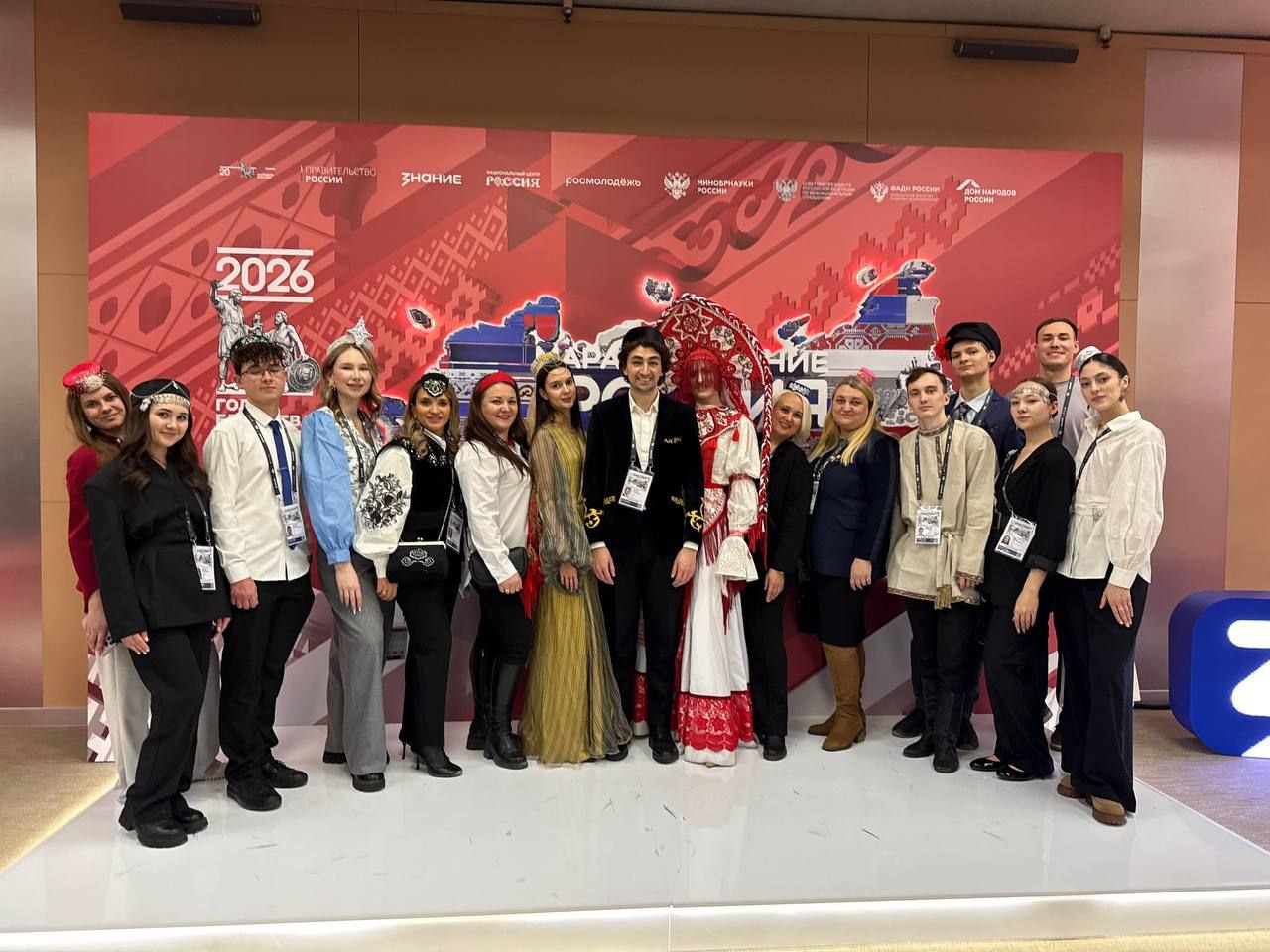
Our students in the bright national costumes of Tatarstan became a living symbol of the country's cultural diversity and were honored to attend the grand opening ceremony, which was attended by the President of the Russian Federation, Vladimir Vladimirovich Putin.
The delegation of the Kazan Innovative University named after Vitaly Gainullovich Timiryasov worthily represented the Republic of Tatarstan at the nationwide opening of the Year of Unity of the Peoples of Russia. The delegation included the most active students and staff of the university.
The central event of the opening was the marathon "Russia - a Family of Families," which brought together more than 4,000 participants and thousands of online viewers in one venue. The program of the event was incredibly rich and multifaceted, reflecting all the richness of the cultures of the peoples of Russia.
Our representatives actively engaged in the work of all thematic spaces:
* During the marathon's lecture program, key topics were discussed: historical memory, cultural heritage, the unifying role of the Russian language, the defense of the Motherland, and traditional values.
* In the masterclass space, participants from KIU familiarized themselves with folk dances and music, saw demonstration performances by sports stars such as Oleg Saitov and Alina Zagitova, and studied modern interpretations of national costumes.
* Particular interest was sparked by the interactive exhibitions – "Heroes of the SVO: The Feat of Unity" and the space dedicated to Russia's 17 traditional values.
* The culmination was the "Friendship Round Dance" – a metaphorical act symbolizing mutual understanding and the unity of all the peoples of the country.
Participation in such a landmark federal event is not only a great honor but also an invaluable experience for the university. It allows for the adoption of best practices, the establishment of new contacts, and the strengthening of work to harmonize interethnic relations within the student community.
ПОДЕЛИТЬСЯ


 ПРЕД
СЛЕД
ПРЕД
СЛЕД