Personal Area
Journal of Digital Technologies and Law Leads Russian Legal Journals in RSCI Impact Factor
Journal of Digital Technologies and Law (https://www.lawjournal.digital) has secured first place among Russian legal publications in both the two-year and five-year RSCI impact factors, outpacing such esteemed publications as “Journal of Russian Law”, “Zakon”, “Bulletin of Economic Justice of the Russian Federation”, “State and Law”, “Perm University Herald. Legal Sciences”, “Pravo. Journal of the Higher School of Economics”, and others.
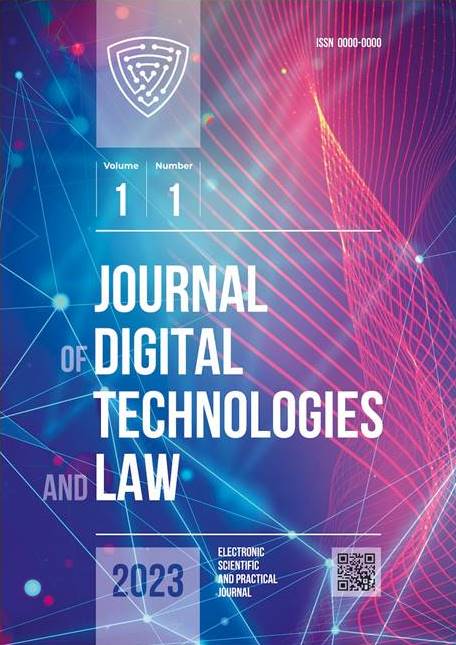
Journal of Digital Technologies and Law is a peer-reviewed periodical scholarly and practical journal dedicated to exploring the synergy between digital technologies and law, as well as the potential risks and threats posed by the interplay of technological progress, digitalization, and legal development.
The journal focuses on pioneering and breakthrough original research into the legal aspects of artificial intelligence and robotics technologies; virtual and augmented reality technologies; wireless communications and quantum technologies; neurotechnologies and advanced manufacturing technologies; big data and distributed ledger systems; the industrial internet and the internet of things; machine learning and human-machine interfaces; cloud and bioprinting technologies; blockchain and cryptocurrencies; unmanned vehicles and drones; smart contracts and tokens; digital platforms and ecosystems; metaverses and digital worlds; smart home and smart city technologies; LegalTech, FinTech, RegTech, SupTech; and other related areas.
The journal also accepts submissions of original research on topics including the ethics of digital technologies, the transformation of law in the context of digitalization, ethical and philosophical-legal aspects of the state's technological development, digitalization of public administration and legal technologies, legal regimes in the sphere of digital innovation and the regulatory framework of the digital environment, legal safeguards for digital security and the protection of digital technologies, digital technologies in lawmaking and law enforcement, countering cybercrime and high-tech crimes, and similar subjects.
According to the current 2025 Science Index Ranking (subject area "State and Law. Legal Sciences"), Journal of Digital Technologies and Law demonstrates impressive dynamics across key scientometric indicators:
The two-year RSCI impact factor stands at 4.750, securing the journal 1st place among Russian legal journals, ahead of publications such as Russian Journal of Economics and Law (3.815), Journal of Russian Law (2.708), and Pravo. Journal of the Higher School of Economics (2.341).
The five-year RSCI impact factor is also 4.750, which likewise ensures the journal's 1st place in the ranking, significantly outperforming Perm University Herald. Legal Sciences (2.858), Russian Journal of Economics and Law (2.613), and Journal of Russian Law (2.540).
In the Science Index Ranking (which accounts for a composite set of indicators), the journal holds 16th place out of 386 legal journals, with a score of 6.626.
It is important to note, however, that unlike the majority of academic journals on the above list, which are indexed in multiple citation systems and databases, including Web of Science, Scopus, the RSCI Core, RSCI, the HAC List, the "White List," and the Unified State List of Scientific Publications, Journal of Digital Technologies and Law is currently indexed only in the RSCI. Despite this, the journal demonstrates the best impact factor indicators among all legal publications in Russia, which attests to the high citation rates and the demand for its published materials within the professional community.
The journal's Editor-in-Chief is Ildar Begishev, Corresponding Member of the Academy of Military Sciences of the Russian Federation, Honored Lawyer of the Republic of Tatarstan, Doctor of Juridical Sciences, Chief Research Fellow at the Research Institute of Digital Technologies and Law, and Professor at the Department of Criminal Law and Procedure of Kazan Innovative University named after V.G. Timiryasov. Commenting on the achievements, he noted:
"High scientometric indicators are, first and foremost, the result of systematic work by the editorial board and a large number of reviewers who ensure rigorous academic scrutiny of each manuscript. We strictly adhere to high peer-review standards: only works that contain genuine scientific novelty and make a tangible contribution to understanding the legal aspects of digital technologies are accepted for publication. The special value of our journal lies in the authors who trust us: leading legal scholars from Russia and specialists from abroad working at the intersection of law and advanced technologies. It is the quality of manuscripts, not formal metrics, that remains the editorial board's top priority."
The Editor-in-Chief also emphasized the journal's international and technologically oriented character:
"Journal of Digital Technologies and Law is a bilingual publication: all articles are published in both Russian and English, making the research accessible to both the Russian and the global academic community. We were among the first legal journals to introduce audio and video abstracts for articles, a modern format that allows readers to quickly grasp the content of the research and enhances the visibility and citation of our authors' work. During the journal's existence, we have collaborated with authors from 42 countries worldwide, from Australia and Brazil to China, the USA, France, and South Africa. Such a broad geographic reach is the best confirmation that issues of legal regulation in digital technologies are truly global in nature today."
Author geography of the journal: Australia, Bangladesh, Belarus, Brazil, Bulgaria, Cabo Verde, China, Cyprus, Czech Republic, Denmark, Ecuador, Egypt, France, Greece, Hong Kong, Hungary, India, Iran, Italy, Kazakhstan, Macao, Malaysia, Mali, Morocco, Netherlands, Nigeria, Philippines, Portugal, Russia, Singapore, South Africa, Spain, Tanzania, Uganda, United Kingdom, USA, Uzbekistan, Zimbabwe.
Such high impact factor indicators confirm the outstanding academic quality of the published materials, the strong demand for the journal within the professional community, and its significant contribution to the development of digital law in Russia and worldwide. The journal continues to strengthen its position as a platform for publishing cutting-edge research at the intersection of digital technologies and law.

 prev
next
prev
next